
Optimised workflow
Deburring and cleaning in a shorter process chain
Deburring and cleaning belong together. Integrating both tasks into the automated workflow of an ultraTEC system can simplify the process between machining and further production. Our comparison shows where separate stations can be eliminated and what this could mean for your production.
- Pre-cleaning
- Manual deburring
- Intermediate cleaning
Separate stations
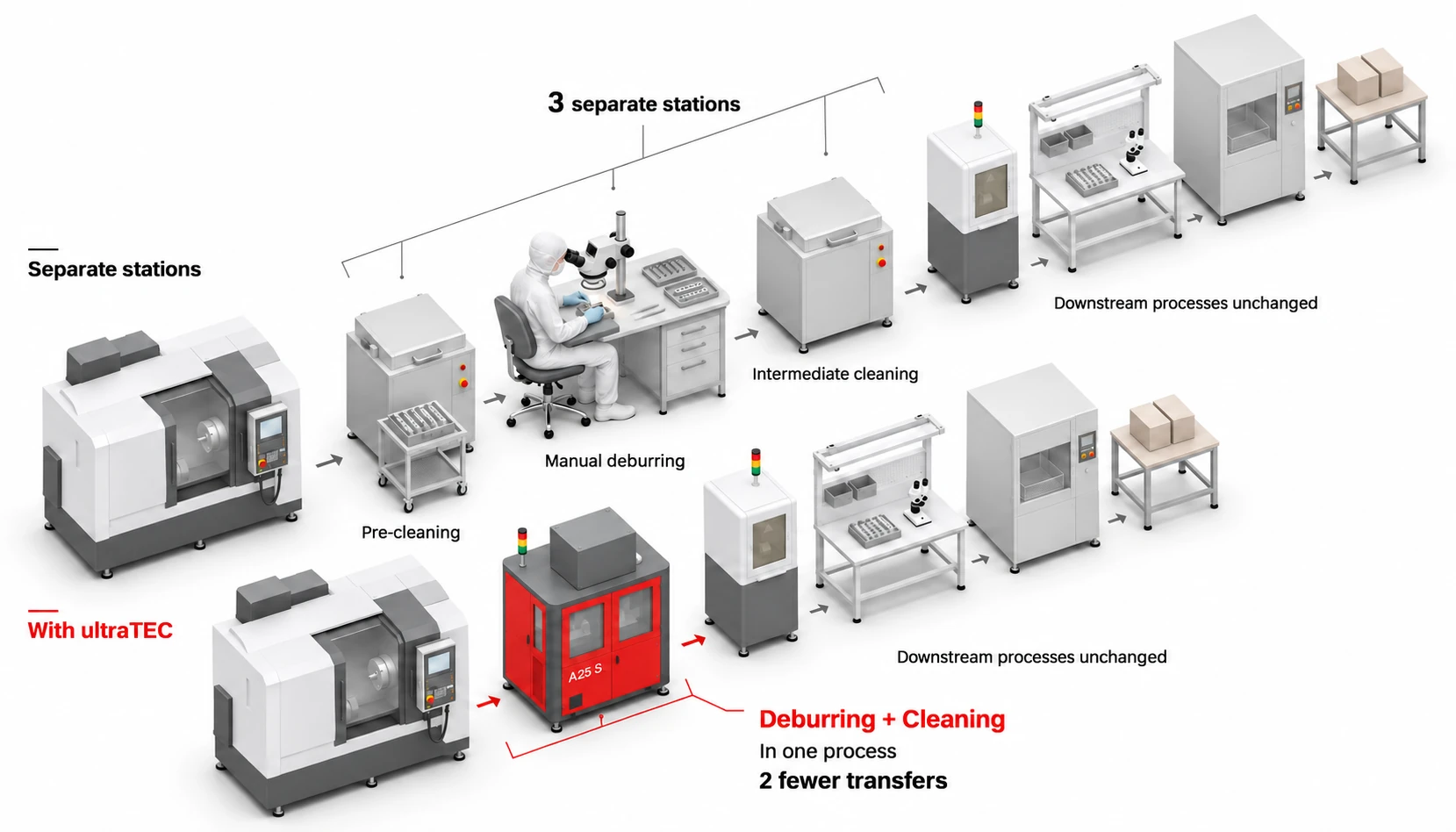
The upper row shows a workflow with three separate steps: pre-cleaning, manual deburring and intermediate cleaning. After CNC machining, the component is first cleaned, then deburred by hand at a workstation and subsequently sent to another cleaning station. Between these stations, it has to be staged and transferred.
With ultraTEC
In the lower row, the A25 S performs the tasks of the three highlighted stations in an integrated process. Deburring and cleaning are combined. CNC machining at the start and the downstream production steps remain in place. The workflow becomes more compact precisely where several separate stations previously followed one another.
Two fewer transfers
In the example shown, one transfer is eliminated between pre-cleaning and deburring, and another between deburring and intermediate cleaning. This reduces the work involved in picking up, setting down and transporting components between these workstations.
This is a key part of the potential benefit: fewer separate stations can also mean less waiting, less work in progress and less coordination. Planning the actual system layout shows which staging areas and transport routes can be reduced.
Automating manual deburring
At the deburring workstation in the upper row, processing depends directly on an operator. In the A25 S, a robot guides the component along a defined path within the sonotrodes’ working area. Prepared workpiece carriers and the system’s part supply support an automated workflow with repeatable processing sequences.
While the system processes prepared components, employees can carry out other tasks. A suitably sized parts buffer provides the basis for longer periods between operator interventions. Loading, quality inspection and system supervision remain part of the planning.
This can reduce production’s dependence on repetitive manual deburring. To achieve consistent results, the processing sequence and parameters are matched to the component geometry, material and existing burrs.
Maintaining the connection to production
The component must be suitably prepared for the downstream processes shown on the right. Whether laser marking, assembly, inspection or packaging: the deburring result and cleanliness are matched to the requirements of the next production step.
Which existing cleaning steps can be replaced depends on contamination and cleanliness requirements. Any required final cleaning remains part of the process chain.
Transfer to neighbouring machines is also considered during configuration. Automated processing within the A25 S and any further automated loading and unloading are planned to suit the existing material flow.
Assessing the entire process segment
The shorter lower row shows where tasks are combined. The resulting economic benefit depends on your existing workflow. Particularly relevant factors include the manual time required per component, handling between stations and actual lead time.
Eliminating transfers and waiting can shorten lead time, even if the processing time itself does not decrease to the same extent. Higher overall throughput also requires the capacities of adjacent production steps to be coordinated.
The potential savings must be weighed against investment, integration and ongoing operation. This overall assessment reveals the automation potential available for your production.
Your component is the starting point
Together, we use your component to assess which of the illustrated steps can be combined in your production. A deburring trial provides the basis for evaluating the deburring result and cleaning effect. We then consider part supply, processing and transfer to the next process.
This turns the schematic comparison into a production concept tailored to your application.