
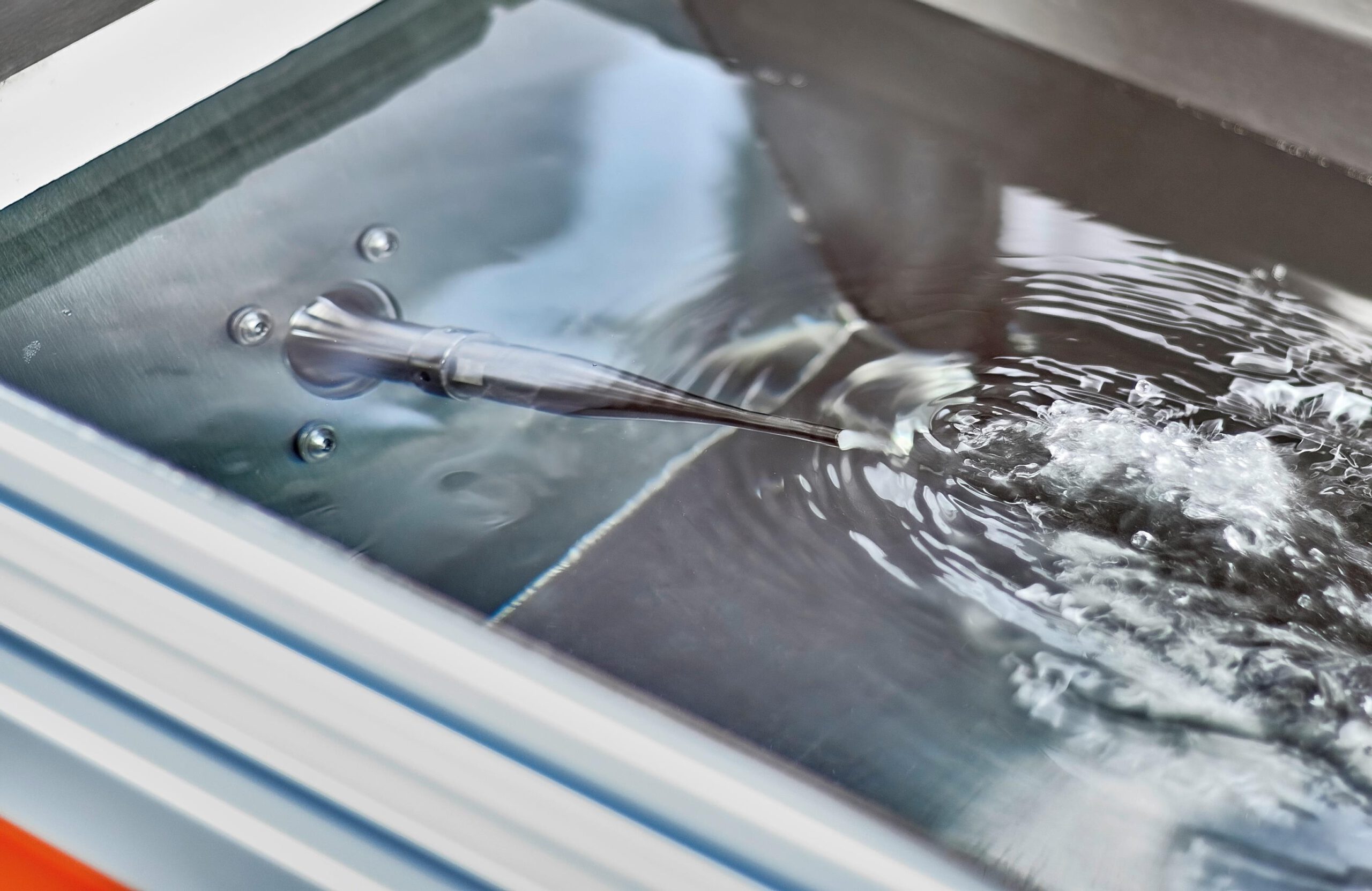
Quality begins in the process.
In medical device manufacturing, deburring involves more than removing burrs. Particulate cleanliness, controlled process conditions and repeatable results are essential to qualifying a manufacturing process.
ultraTEC takes these requirements into account when designing its ultrasonic deburring systems. Material selection, process water management, temperature control and automated component handling work together.
This gives medical device manufacturers a process environment they can control to meet the quality requirements of their application.
Particles and residues
When machining medical components, manufacturers have to remove burrs and carry the released particles away from the component in a controlled manner.
Particulate cleanliness starts during machining
Internal features, intersecting bores and through channels present a particular challenge. Residues left in these areas can make subsequent cleaning more difficult.
Ultrasonic deburring dislodges burrs from the component. At the same time, process water flushes loose particles out of the treatment zone. The robot positions the relevant features in front of the sonotrode so that particle removal can be taken into account when programming the operation.
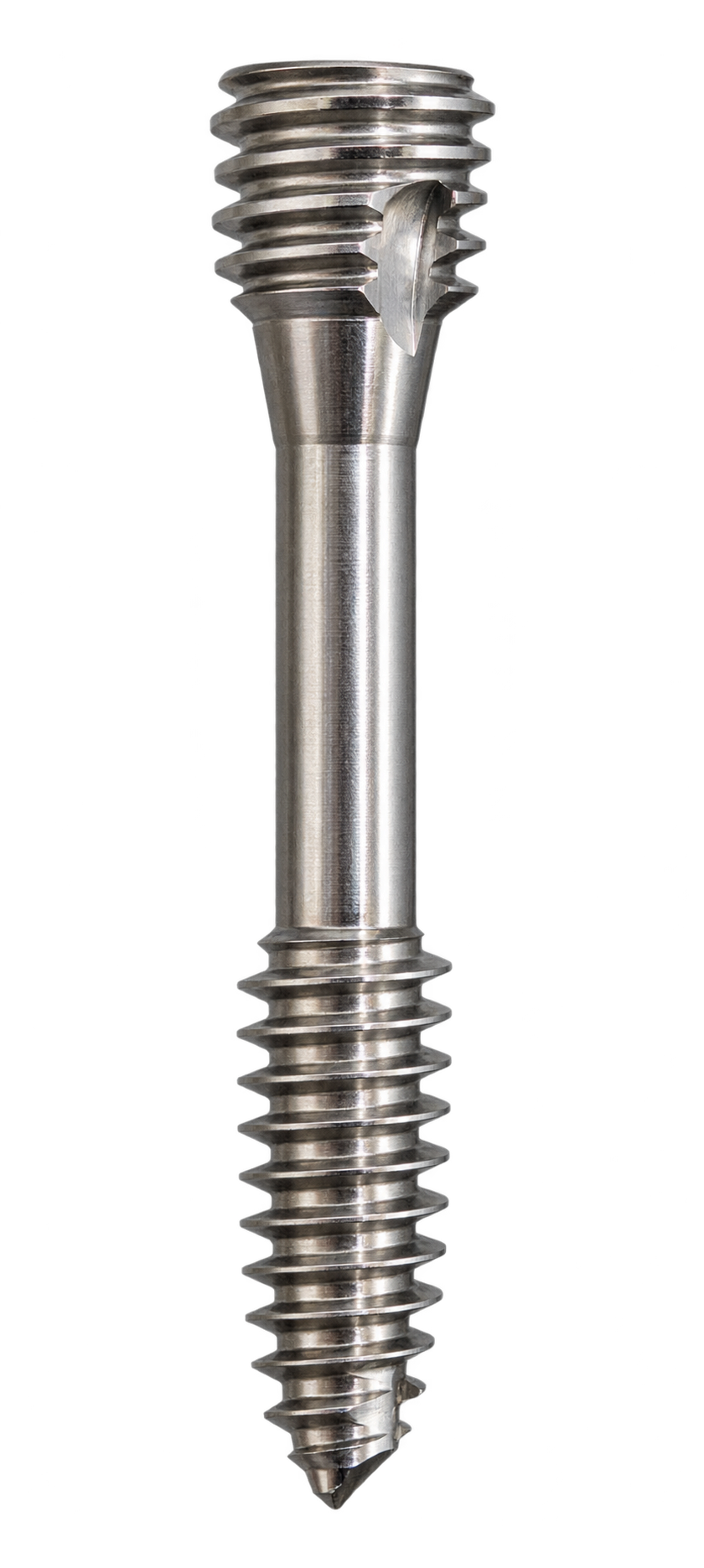
In cannulated implant screws, for example, internal features can be positioned for treatment and flushed with process water.
One operation combines burr removal with the removal of loose particles.
The flushing action is an integral part of the process. Water in the treatment zone reaches local flow velocities of up to 25 m/s and carries away detached burrs, particles and adhering machining residues, including those in internal features.
Cleanliness before final cleaning
A study conducted as part of the German Jugend forscht research competition compared two groups of three titanium bone screws of the same design. Before final cleaning, the screws without ultraTEC treatment carried between 70 and 220 particles per screw in the 2–5 µm size range. All three ultraTEC-treated screws were below the detection limit of six particles per screw.
The researchers also measured the endotoxin load on the screws. The three comparison samples without ultraTEC treatment ranged from 0.8 to 1.4 endotoxin units (EU) per screw. All three treated samples were below the respective detection limit.
The cytotoxicity test measured inhibition of test cell growth. For the ultraTEC-treated samples, growth inhibition was 0% in the initial test and 3% in the repeat test. The corresponding results for the samples without ultraTEC treatment were 4% and 8%.
Source: Project report “ultraTEC – und der Grat ist weg!”, sections 4.4–4.6, p. 15.
Flushing depends on how the system manages its process water. Circulation, filtration, cooling and regular water changes are designed to keep removed contaminants from returning to the components. The level of cleanliness achieved is verified on the component.
A controlled process environment
Every component in contact with the process water can influence conditions in the circuit. Material compatibility and potential sources of contamination therefore need to be considered when designing the equipment.
- Process water circuit
- Stainless steel tank and main water-carrying components, with flexible hoses
- Fittings
- Stainless steel available as an option
- Process water
- Demineralised water as standard
- Sonotrodes
- Grade 5 titanium
- Gripper materials
- Biocompatible materials available as an option
- Water filtration
- Two replaceable filter elements
- Temperature monitoring
- Processing enabled below 15 °C
Selecting materials for water and component contact
ultraTEC uses stainless steel for the process tank, fasteners and relevant water-carrying components of the cooling system. Flexible hoses connect parts of the circuit. Stainless steel fittings are available on request.
The sonotrodes are made of Grade 5 titanium as standard. Biocompatible materials are available as an option for the component grippers.
These choices are relevant to medical device manufacturers assessing contact materials as part of their contamination and risk assessments.
Managing process water throughout the circuit
The A25 S has a process water circuit with a capacity of approximately 36 litres. During operation, the water circulates continuously through two replaceable filter elements.
The filters retain particles released during treatment and limit their return to the treatment zone.
The system uses demineralised water as standard.
The system includes a fresh water inlet and a drain connection. Water change intervals depend on the contamination load. Cutting oils and other machining residues can make an earlier change necessary.
Circulation, filtration, cooling and water changes are all part of the equipment design. Compared with warmer baths, process temperatures below 15 °C can slow the growth of many microorganisms. Alongside regular water maintenance, this supports a controlled process environment for medical device applications.
The particulate and microbiological water quality required for each medical device must be defined and verified for the application.
Temperature-controlled release below 15 °C
Process water temperature influences cavitation conditions and, in turn, the effect of ultrasonic treatment.
The system actively cools the entire process water circuit and monitors its temperature.
The controller enables processing only when the water temperature is below 15 °C.
The temperature check is built into the machine control system and runs automatically.
For series production of medical devices, this means that the system checks an important process condition before treatment begins.
Repeatability and validation
With manual deburring, differences in handling and treatment time can affect the result.
Automated component handling during deburring
An ABB industrial robot guides the component throughout the deburring cycle, automating the manual deburring step.
Component-specific paths are programmed at an external CAD/CAM workstation. Operators can adjust process parameters directly at the machine’s control panel.
Component positions, movements and working distances are defined in the program. The ultrasonic parameters are also specified for each application.
The program controls how the component is guided throughout the deburring operation.
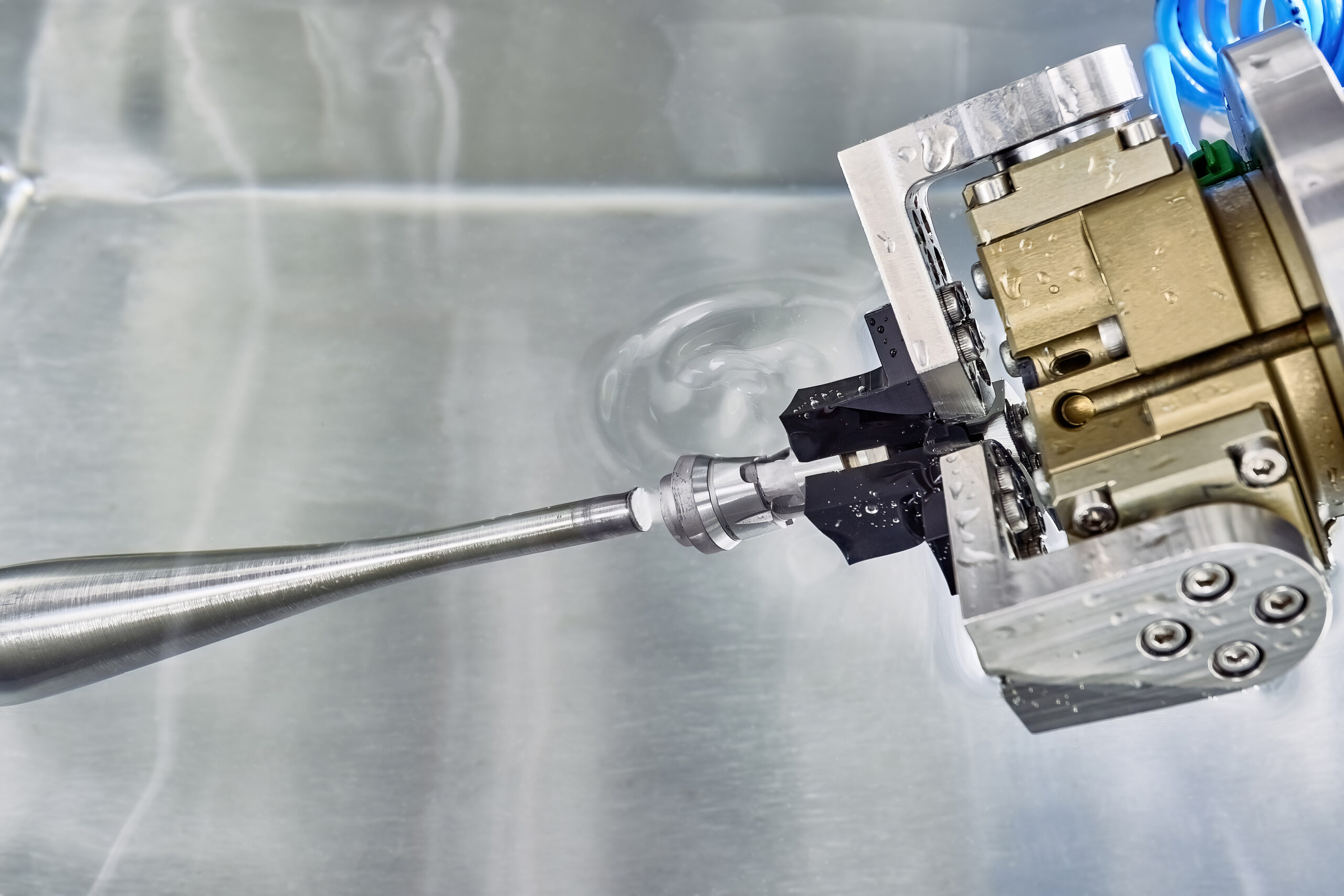
Defined conditions provide a basis for validation
Medical device manufacturers need evidence that the process consistently meets their specified quality requirements.
The design of ultraTEC systems supports this work.
The robot follows defined paths, the ultrasonic parameters are specified and the controller checks the process temperature before enabling the cycle.
These conditions can be incorporated into qualification of the process for the intended application.
ultraTEC provides design qualification (DQ) documentation for the equipment and supports process FMEA.
The quality characteristics, test methods and acceptance criteria are defined, and the process is validated, according to the medical device manufacturer’s requirements.
The system gives manufacturers defined, traceable processing conditions alongside their product quality checks.
The complete manufacturing sequence
Fewer process steps and component transfers
In medical device manufacturing, every additional processing or handling step can introduce opportunities for error or contamination.
ultraTEC combines automated burr removal with flushing in the same operation. In suitable applications this can eliminate a separate preliminary or intermediate cleaning step.
An operation that previously required several stations can therefore be organised as a shorter sequence.
Automating deburring can also reduce component transfers, handling effort and the number of interfaces that operators need to manage.
Whether a cleaning stage can be eliminated depends on the residues present and the component requirements. Final cleaning requirements for the medical device must be assessed separately.
The economic benefit extends beyond processing time to a simpler manufacturing sequence that is easier to control.
Designing quality into the equipment
At ultraTEC, Quality by Design means addressing the requirements for a controlled deburring process from the outset of equipment development.
Material selection, the integrated process water circuit, temperature-based cycle release and fully automated component handling are specific design decisions.
Together they provide the basis for developing a component-specific deburring process under defined conditions and integrating it into qualified series production.
Quality begins with the design of the equipment, well before the finished component reaches inspection.